 Keep Above
What is a sinking fund, and which bills need one?
Car registration, insurance, council rates: the bills that arrive in one lump, once or twice a year. A sinking fund is the old name for setting a slice aside each pay so the full amount is there on the day.
How much of each bill goes aside each pay?
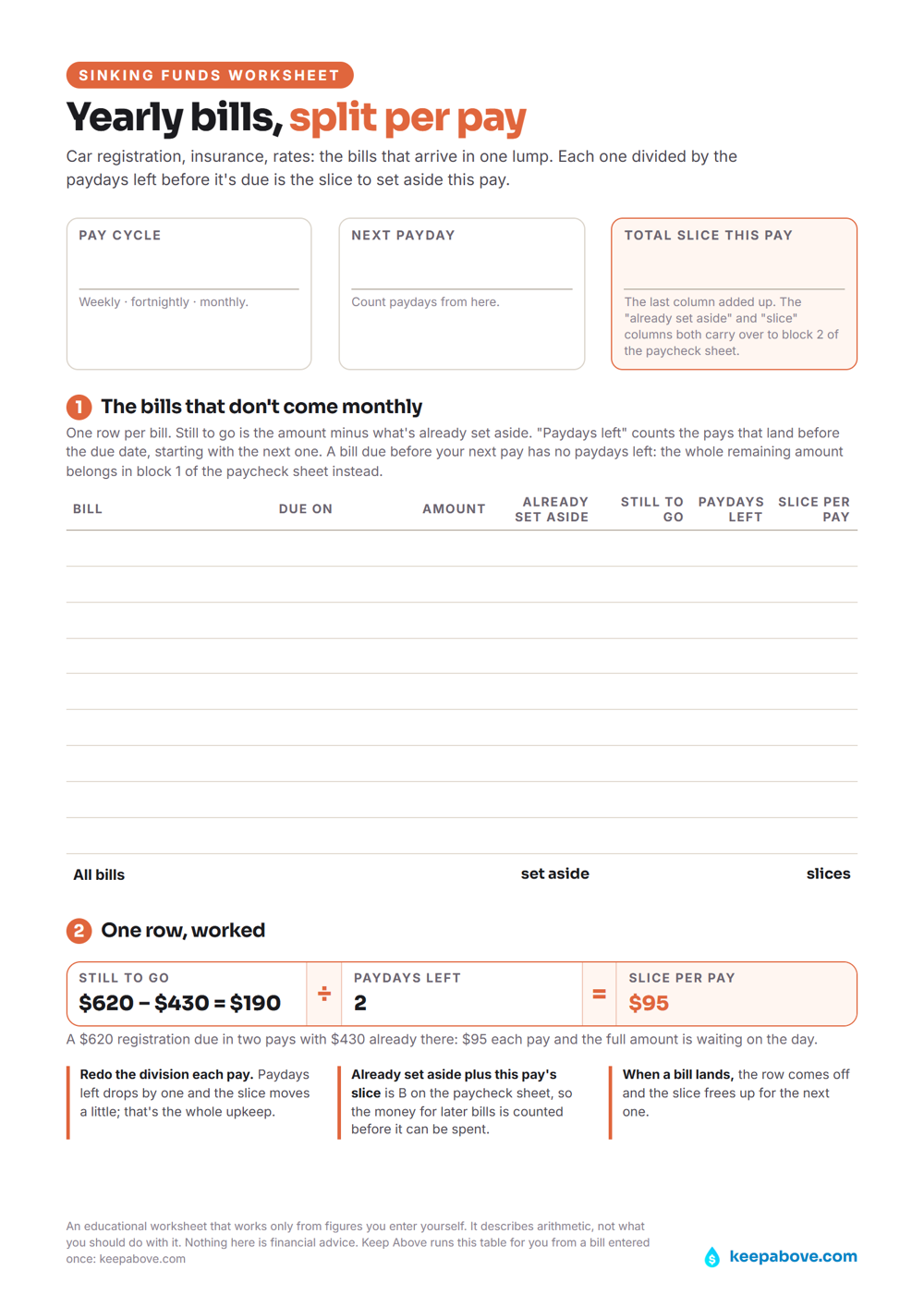
One row per bill. Amount, what's already set aside, what's still to go, and how many paydays land before the due date, starting with the next one. Still to go divided by paydays left is the slice for this pay. Already set aside plus this pay's slice carries over to block 2 of the paycheck sheet as B, so the money for later bills is counted before it can be spent.
The sheet carries one worked row: a $620 registration due in two pays with $430 already there is $95 a pay. Redo the division each pay and the slice adjusts itself; that is the whole upkeep.
The reasoning behind it is in the blog: Bills that don't come every month. The other two worksheets are on the worksheets page.
Common questions
What is a sinking fund?
A slice set aside each pay so a bill that arrives once or twice a year is already covered on the day. Car registration, insurance and council rates are the usual ones. The money stays in your account; it is simply counted as spoken for before it can be spent.
How do I work out how much to set aside each pay?
Take what is still to go on the bill and divide it by the number of paydays left before it is due, counting the next one. The worksheet carries a worked row: a $620 registration due in two pays with $430 already set aside is $95 a pay.
What happens when the amount or the due date changes?
The division is redone from the figures as they stand, and the slice adjusts itself. That is the whole upkeep of the sheet: still to go, divided by paydays left, each pay. A larger amount or a nearer date raises the slice; the opposite lowers it.
How does this sheet connect to the other two?
Already set aside plus this pay's slice is the figure that carries into block 2 of the paycheck sheet as B. That is what makes the subtraction on that sheet hold back the money for later bills, so what is left over is not counting money that is already spoken for.
Do I need a separate account for each fund?
No. The sheet tracks the amounts on paper, so one account can hold every fund at once and the row for each bill records what is set aside against it. Keep Above works the same way and does not move or hold money at all.
Does Keep Above work sinking funds out for me?
Yes. It runs the same division for every bill you add, and projects the funds forward day by day alongside your balance, up to 30 years ahead. It shows the arithmetic and does not move or hold money, so paying the bill stays with you.
Keep Above is an educational planning tool that works only from the figures you enter yourself. The worksheet describes arithmetic, not what to do with it. It doesn't hold, move or access your money, and nothing here is financial advice.