 Keep Above
Most household bills are easy to plan around because they turn up on a rhythm you already feel. Rent or the mortgage, the phone, the streaming subscriptions — they arrive monthly, they're roughly the same size each time, and a monthly budget absorbs them without much thought.
The awkward ones are the bills that don't do that. Car registration. Home and contents insurance. Council rates. An annual professional membership. They arrive once or twice a year, they're several hundred dollars each, and they land in a single lump on a week that looks like every other week.
The arithmetic is not complicated. A $620 car registration due in eight months, on a fortnightly pay cycle, is about $36 a fortnight. What makes it hard in practice isn't the sum — it's that the sum has to be remembered, redone whenever the amount or the date changes, and held separately from the balance you look at when deciding whether you can afford something this week. The number in your account says one thing; the number you can actually spend says another.
What is a sinking fund?
The technique itself is old and has a name: a sinking fund. Rather than meeting a large irregular bill out of whatever happens to be in the account on the day, a portion is set aside on each pay so the full amount has accumulated by the time the bill is due. The bill stops being an event. It becomes a line that was already accounted for.
The concept is simple enough to run on paper, and plenty of people do — a spreadsheet, a second savings account per category, envelopes. What those approaches share is upkeep: every one of them needs the split recalculated when a due date moves or a premium goes up, and each of them keeps the answer somewhere other than where the spending decision gets made.
How does Keep Above handle a bill that comes once a year?
Keep Above treats this as the default rather than a technique to set up. A bill is entered once — amount, how often, when it's next due — and from then on the app works out what each payday needs to contribute and tracks how much has accumulated.
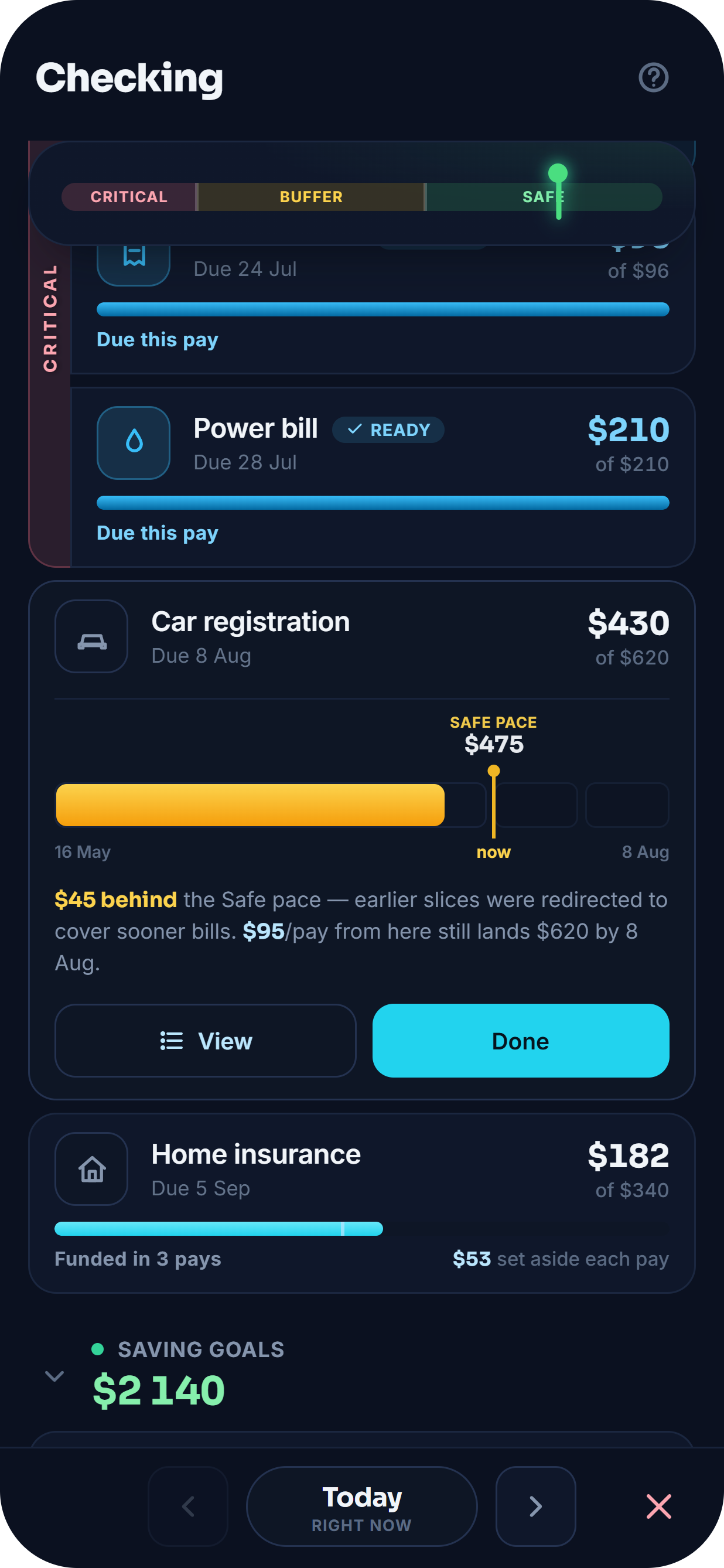
On the Reserved Funds screen the bills being saved for are listed with what's set aside against what's needed: a car registration might read $430 of $620, due 8 August, funded in two pays at $95 each. Saving goals sit alongside them and work the same way — a target and a date, divided across the paydays in between.
Above that list is a single figure for what's set aside in total, and the balance measured against it. When the balance sits above the point where every bill and goal is covered in time, the surplus is stated plainly as what isn't allocated to anything. That is the number worth knowing before spending, and it isn't the account balance.
Two reference levels. Keep Above works out Critical — enough to cover the bills due before your next income arrives — and Safe, the point where every upcoming bill and goal you've entered is set aside in time.
The sinking funds on this page are what the Safe line is made of.
The date can be stepped forward. Doing so re-runs the projection: each fund would fill a little further with every payday that passes, and the ones that reach their bill drop off the list once it's paid. It's a projection from the figures entered, over the horizon the app can see — not a prediction.
Why does Keep Above keep no spending history?
There's a design decision underneath all of this worth being explicit about. Keep Above keeps no spending history. It doesn't categorise past transactions or produce a report on where last month went, because the question it's built for is the forward one: given what is already committed, what is genuinely free right now?
That makes the ongoing effort small. There are no receipts to log and no transactions to categorise. Bills are entered once, and the balance is the one figure kept current. As a consequence the app doesn't need a connection to a bank account to be useful — it works from figures entered by hand, which is also what lets it work the same way in any country.
Keep Above is on Google Play and the App Store. One budget is free; more budgets are included from US$6.99 a month.
Common questions
How much do I set aside each payday for a yearly bill?
It is the amount divided by the number of paydays between now and the day it falls due. A $620 car registration due in eight months, on a fortnightly pay cycle, works out at about $36 a fortnight. Keep Above does that division for every bill entered, and redoes it when an amount or a due date changes.
Which bills do not come every month?
Car registration, home and contents insurance, council rates, an annual professional membership — the ones that arrive once or twice a year in a single lump. They are awkward not because the amount is unknown but because the week they land looks like every other week, and the balance in the account does not distinguish them.
Where does Keep Above show what is set aside so far?
On the Reserved Funds screen, which lists each bill being saved for with what is set aside against what is needed — a car registration might read $430 of $620, due 8 August, funded in two pays at $95 each. Saving goals sit alongside them, a target and a date divided across the paydays in between.
Does the app actually move the money somewhere separate?
No. Keep Above shows the arithmetic and nothing else — it does not hold, move or access money, and there is no second account behind the scenes. The money stays where it is; what the app does is state how much of the balance is already accounted for by bills that have not arrived yet.
What happens to a fund once the bill is paid?
It drops off the list once the bill is paid, and the projection re-runs without it. Stepping the date forward shows each remaining fund filling a little further with every payday that passes. That is a projection from the figures entered, over the horizon the app can see, rather than a prediction.
Can I do this in a spreadsheet instead?
Yes — the technique is old and runs on paper, a spreadsheet, a second savings account per category or envelopes. What those share is upkeep: each one needs the split recalculated when a due date moves or a premium goes up, and each keeps the answer somewhere other than where the spending decision gets made.
Keep Above is an educational planning tool that works only from the figures you enter yourself. It doesn't hold, move or access your money, and nothing here is financial advice.