 Keep Above
Payday has a particular feeling to it. The money lands, the balance looks healthy, and for a day or so everything seems fine. Then the ordinary machinery of the fortnight starts up: rent goes out, the power bill lands, the car needs fuel, groceries happen twice. By a few days before the next pay, the balance is a different kind of number — and the distance between those two numbers can be hard to see from inside the week.
What sits between one payday and the next isn't really a mystery, though. Most of it is arithmetic that was settled before the fortnight began: the bills you already know about, for amounts you already know, on days you already know. The part that feels like uncertainty is mostly just that nobody has done the sum — taken the balance as it stands, laid the known bills against the days they fall due, and read off what's genuinely left over.
What does "already spoken for" mean?
Take a fortnight that starts with $2,800 in the account. Rent of $1,600 comes out in week one. Power is $160 this cycle, groceries run about $180 a week, and the phone bill lands two days before the next pay. None of that is a surprise; all of it is dated. Add it up and roughly $2,300 of that opening balance was never really available — it was spoken for the moment the fortnight began, just not labelled that way anywhere.
The balance a bank app shows doesn't make that distinction. It reports what's in the account now, and leaves the forward arithmetic — what's committed between now and the next pay — to be done in your head, every time, against dates you have to remember. That sum is easy to do once and tedious to keep doing, which is why it mostly doesn't get done.
What do you have to enter, and how often?
Keep Above exists to hold that arithmetic so it doesn't have to be redone. It runs on two inputs. The first is the bills — entered once, with an amount, a frequency and a due date, and edited only when something changes. The second is the balance: one number, typed in whenever you like. From those, the app projects the budget forward day by day and shows the line the balance needs to stay above for everything that's coming to be covered.
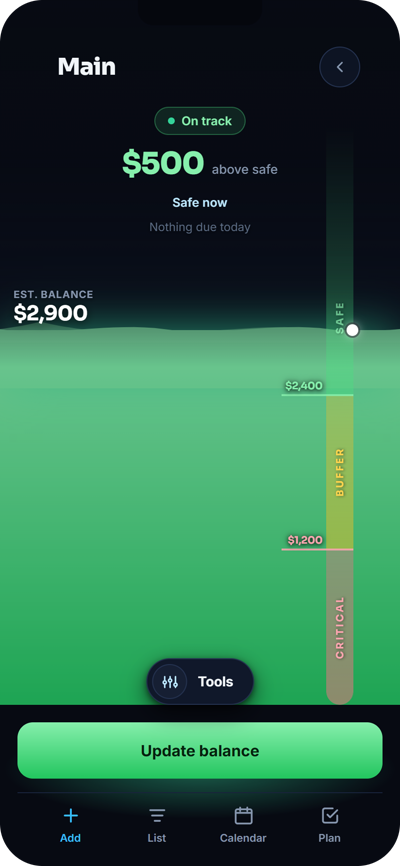
That's the whole routine. There's no step three — no receipts to log, no transactions to categorise, no end-of-week catch-up session. A week where you don't open the app costs nothing, because the app isn't keeping a diary that falls behind; it's holding a projection that's still there, built from the same bills, waiting for the next balance you type in.
Two reference levels. Keep Above works out Critical — enough to cover the bills due before your next income arrives — and Safe, the point where every upcoming bill and goal you've entered is set aside in time.
What sits above the Safe line is the figure the app was built to show: what isn't allocated to anything.
How does the calendar show the days between paydays?
The same projection feeds a calendar, where each day between paydays carries its own level: green where the balance would sit above what that day needs, amber where it would run close, and flagged where a dated bill would push it under. A tight day two Thursdays from now shows up as a tight day two Thursdays from now — before it arrives, while the fortnight can still be arranged around it. It's a projection from the figures entered, not a prediction; if a bill changes, the picture changes with it.
The bills that don't come every fortnight — registration, insurance, rates — get the same treatment by a different route: a slice of each pay is set aside toward them, so the lump is already accounted for when its date comes round. That's its own subject, and it's what the Safe line is made of.
The 40-second version
Because the app works from figures entered by hand, it doesn't need a connection to a bank account — which is also what lets it work the same way in any country. Keep Above is on Google Play and the App Store. One budget is free; more budgets are included from US$6.99 a month.
Common questions
How much can I spend before my next payday?
It is the balance you hold today minus every bill dated between now and your next income; what is left is the part that is not already spoken for. Keep Above holds that sum so it does not have to be redone — bills go in once with an amount, a frequency and a due date, and the balance is one number typed in whenever you like.
Why does my balance look healthy right after payday?
Because a balance reports what is in the account at that moment, not what is already dated against it. A fortnight that opens with money in it can have most of that money spoken for by rent, power, groceries and a phone bill that have not left yet — all of them known amounts on known days.
What is the difference between Critical and Safe?
Critical is enough to cover the bills due before your next income arrives; Safe is the point where every upcoming bill and goal you have entered is set aside in time. Keep Above works out both from the figures you enter, and shows where your balance sits against them. What sits above the Safe line is what is not allocated to anything.
Do I have to track every purchase to know what is left?
No. Keep Above keeps no spending diary, so there are no receipts to log and no transactions to categorise — the two inputs are the bills, entered once, and the balance, typed in whenever you like. A week you do not open the app costs nothing, because the projection is still there, built from the same bills.
How far ahead does Keep Above project?
Up to 30 years ahead, on the free tier as well as Premium. The projection runs day by day from the bills, income and balance you have entered, so a tight day weeks out shows as a tight day weeks out. It is a projection from the figures entered, not a prediction; change a bill and the picture changes with it.
Does Keep Above connect to my bank account?
No, and it cannot. Keep Above works only from figures you enter yourself — no logins, no card numbers, no account details — which is also what lets it work the same way in any country. It does not hold, move or access money, and it does not know your real balance unless you type it in.
Keep Above is an educational planning tool that works only from the figures you enter yourself. It doesn't hold, move or access your money, and nothing here is financial advice.